How Do I Know If Repair or Replacement Is Better for My Lake Mary Ducts?
Two contractors looking at the same Lake Mary duct system will quote you estimates between $600 and $6,200. That spread comes down to six factors our technicians check before writing any number on paper. Air duct repair in Lake Mary starts with an honest attic inspection, and this page walks through the exact checklist we run on every job.
The homeowners who call us are usually already living with the symptoms — a bedroom ten degrees warmer than the living room, a July power bill 30 percent higher than last summer's, and a musty smell that settles into the return vent every time the blower kicks on. Somewhere above the ceiling, the ductwork is losing the fight, and the question is whether you patch it or tear it out.
TL;DR Quick Answers
Filterbuy HVAC Solutions repairs leaky, torn, and disconnected ducts in Lake Mary homes using four methods matched to what we find in your attic: Aeroseal pressurized sealing, manual patch and repair with UL-181 foil tape and mastic, antimicrobial duct coating, and partial section replacement.
What it costs: Most Lake Mary duct repairs run $200 to $800. Aeroseal whole-system sealing ranges from $1,500 to $3,500.
How long it takes: Two to four hours for a standard repair. Four to six hours for Aeroseal.
When repair is the right call: System under 15 years old, damage localized to one or two spots, liner intact, repair cost under 50 percent of replacement cost.
When replacement beats repair: System past 15 years, multiple failed sections, sagging or mold-stained liner, or a repair that would only hold one more summer.
What to expect: A free attic inspection, a pressurization test, a fixed upfront quote, a one-year labor warranty, and 24/7 scheduling at (754) 231-4634.
Why Lake Mary ducts fail faster: Florida ducts last 10 to 15 years, shorter than the 20-year national average, because of 130-degree attic temperatures, year-round humidity cycling, and UV exposure through roof vents.
Top Takeaways
Florida ducts typically last 10 to 15 years, shorter than the 20-year national average, because of attic heat and humidity cycling.
When a repair quote crosses 50 percent of replacement cost, replacement almost always delivers better long-term value.
Localized damage on a younger system usually calls for a repair, while widespread damage or mold on an older system usually calls for replacement.
Our four repair methods (Aeroseal, manual patch, antimicrobial coating, partial replacement) each fit different situations, and we match the method to the attic we walk into.
A real decision requires an attic inspection and a pressurization test. Phone estimates on duct repair are educated guesses at best, which is why we do not give them.
Sealing leaky ducts recovers up to 20 percent of lost HVAC efficiency, which shows up on your next power bill.
Waiting two summers to act is the single most expensive choice most Lake Mary homeowners make with their ductwork.
The Decision Framework We Run in Lake Mary Attics
Six factors drive the call. No single one decides it on its own, but any two together usually point clearly toward one answer or the other.
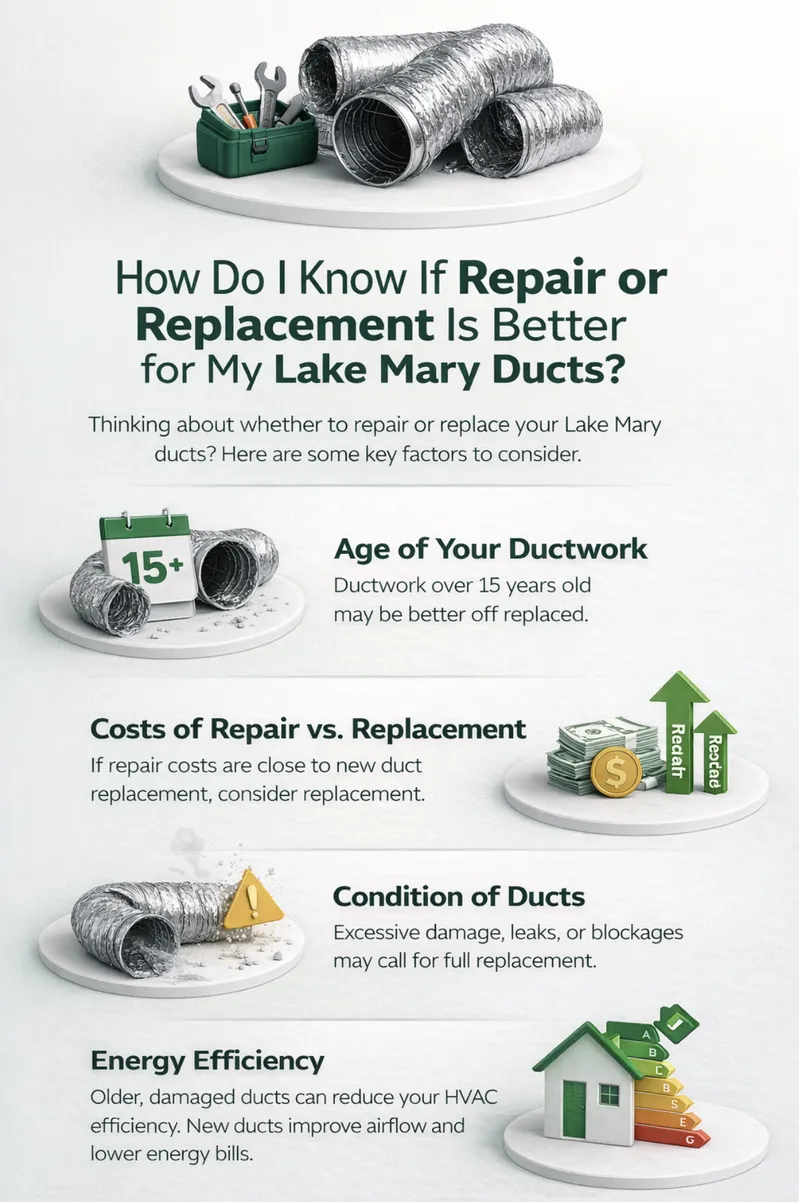
Duct age. Florida ducts last 10 to 15 years on average, shorter than the 20-year national benchmark. Attic temperatures above 130 degrees in summer, year-round humidity cycling, and UV exposure through roof vents wear flex-duct down faster here than in cooler climates. If your system is under 15 years old, repair is usually on the table. Past that mark, we start the replacement conversation honestly with you from the first visit.
Damage location and pattern. A single tear in one flex run is a different situation than a system where every joint is sweating, sagging, or pulling apart at once. Localized damage in one or two accessible spots almost always points to a repair, while widespread damage across multiple runs or the main trunk usually pushes the honest answer toward replacement.
Leakage rate. Every duct system leaks some amount. A properly sealed Florida system runs under 20 percent total leakage, and a pressurization test (also known as a duct-blaster) gives the exact number. Below 20 percent with localized sources, we seal the leaks and move on. When the number climbs above 30 percent and the origins are scattered, sealing usually only buys one more summer before the next joint fails.
Visible condition. When we pull insulation back, we are looking at one of two pictures. The first is an intact liner with an outer jacket still holding its shape and no brown staining along the seams. That air duct is structurally sound, and a repair will hold. The second picture is sagging flex, collapsed runs, mold discoloration on the inner liner, or fiberglass shedding into the airstream. That duct has become the problem itself, and replacement is the better spend.
Estimate cost versus replacement cost. Most Central Florida HVAC contractors work off one rule of thumb here. When a repair quote passes roughly 50 percent of what a full replacement would cost, replacement almost always delivers better long-term value. A $2,500 repair on a system that would cost $5,000 to replace rarely gives the homeowner what they paid for, because the new work is bolted onto old ducts that will fail again within a few years anyway.
System compatibility. Ductwork sized for a 4-ton AC installed in 1998 will not perform the way it should with a high-efficiency 3-ton system put in last year. Mismatched sizing is a replacement trigger on its own, even when the existing ducts look structurally sound from the outside.
When Air Duct Repair in Lake Mary Is the Right Call
The repair case stacks up cleanly when the system is under a decade old, two or three leaks sit in accessible spots, the liner is intact, and the estimate lands somewhere in the $200 to $800 range. Depending on what we find once we are in the attic, we reach for one of four methods.
Aeroseal pressurized sealing is our go-to when the system is structurally sound but leaks are scattered across joints we cannot easily reach by hand. Manual patch and repair, using UL-181 foil tape, mastic, and spray adhesive, handles identified joint failures at takeoffs, plenums, and boots. Antimicrobial duct coating goes on after a thorough cleaning to reinforce porous surfaces and prevent future mold. Partial replacement is the right answer when two or three specific runs need to come out without disturbing the rest of the system.
When Replacement Is the Honest Recommendation
We tell homeowners to replace when the system is past 15 years, when multiple failed sections mean patching one run only exposes the next weakest link within a year, or when mold on the inner liner cannot be fully remediated through cleaning and coating. We prefer to have these conversations straight with you, even when replacement is the more expensive answer, because it saves you from paying twice—once for the repair, and once for the replacement eight months later when the next joint lets go. Often, homeowners ask how much difference do air purifiers make when ducts are failing; the truth is, even the best filtration can’t compensate for leaky, contaminated ductwork.
Lake Mary's climate is the real reason these numbers skew the way they do. Summer attic temperatures in Seminole County regularly push past 130 degrees Fahrenheit, and the daily humidity cycle between afternoon thunderstorms and overnight cooling puts every joint through a stress test most of the country never sees. Ducts in a Lake Mary home have run harder by year 12 than ducts in a Chicago suburb will run by year 22. To maintain indoor air quality during these peak seasons, many residents explore the benefits and risks of HEPA and ionizing air purifiers as a secondary defense against the allergens and humidity-driven particulates that compromised ducts can introduce into the home.
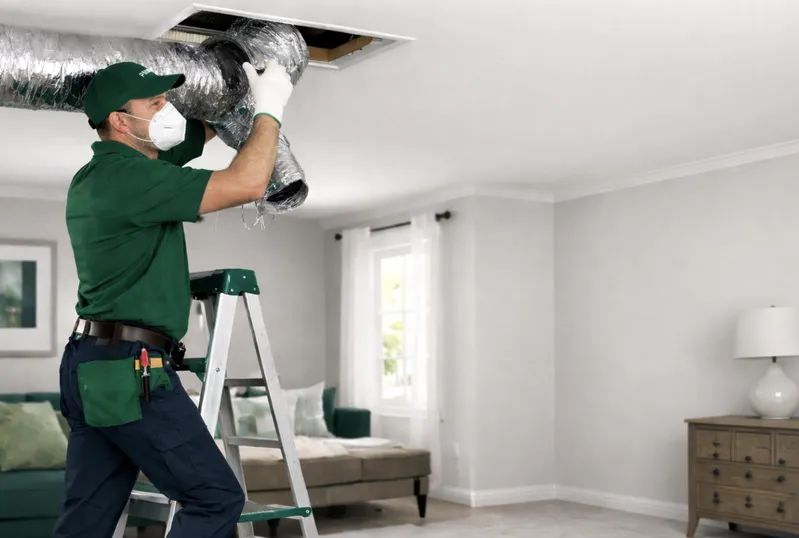
"In a Lake Mary attic, nine times out of ten the decision comes down to the liner. If the inner jacket is still holding its shape and the damage is sitting at the joints, we can seal it and give you another ten years. A sagging or mold-spotted liner is a different story, and I tell the homeowner that straight. We are looking at replacement, even when they were hoping for a patch. Thirty years of Florida attic work has taught me that nothing ages ducts faster than summer heat cycling against the topside of insulated flex. The Heathrow homes built in the late '90s are the ones we see most right now, and the honest answer on those is almost always replacement."
7 Essential Resources
Each reference below comes from a verified .gov or .edu source. These are the same materials our team pulls from when we are building an honest case for repair or replacement on your system.
ENERGY STAR — Duct Sealing Guide
The federal ENERGY STAR program publishes this homeowner-facing guide on duct sealing, and it is the source behind the 20-to-30-percent leakage figure cited in our first statistic. The page walks through how to spot a leaky system, which materials (mastic sealant and metal-backed foil tape) actually hold in a Florida attic, and which zones to prioritize first. The companion "Benefits of Duct Sealing" page, linked from the same guide, is where the up-to-20-percent efficiency improvement figure originates. For a Lake Mary homeowner, the guidance maps almost exactly onto the vented-attic, flex-duct systems our crews see every week. https://www.energystar.gov/saveathome/heating-cooling/duct-sealing
U.S. Department of Energy — Minimizing Energy Losses in Ducts DOE's technical overview of residential duct design, leakage, and sealing. This is the page our technicians reference when explaining return-side versus supply-side leakage during an attic inspection, and it is the federal origin of the recommendation to locate ducts inside conditioned space when possible. The guide covers duct pressurization, return air problems caused by closed interior doors, jumper ducts, and the structural upgrades that fix common distribution issues. For older Lake Mary homes where return-side leakage in attic-mounted air handlers is almost universal, this resource gives you the vocabulary to ask informed questions during any estimate. https://www.energy.gov/energysaver/minimizing-energy-losses-ducts
U.S. Environmental Protection Agency — Should You Have the Air Ducts in Your Home Cleaned? The EPA's consumer guide (publication EPA 402-K-97-002) on deciding when duct work warrants service. It is the document we reference most often when a Lake Mary homeowner calls to ask whether their ducts need cleaning, sealing, or replacement. The EPA lays out three specific triggers that push the decision toward replacement rather than cleaning: visible mold growth inside hard-surface ducts, wet or moldy insulation inside insulated ducts (which the EPA notes cannot be effectively cleaned and should be removed), and vermin infestation. Each of those triggers maps directly onto the replacement criteria in our decision framework. https://www.epa.gov/indoor-air-quality-iaq/should-you-have-air-ducts-your-home-cleaned
U.S. Energy Information Administration — Residential Energy Consumption Survey EIA's Residential Energy Consumption Survey (RECS) is the federal government's primary data source on how U.S. households use energy. The 2020 edition was the first to break data out by all 50 states, which is how we can cite the 96 percent Florida air conditioning adoption figure in our third statistic with confidence. For Lake Mary homeowners, the Florida state-level data confirms what our crews see every day: nearly every household runs central AC twelve months a year, which means ductwork condition shapes comfort, energy use, and indoor air quality more here than in almost any other state. https://www.eia.gov/consumption/residential/
Florida Solar Energy Center, University of Central Florida — Duct Leakage Research in Florida Homes FSEC is a research institute of the University of Central Florida, and the study linked here is "Impacts of Duct Leakage on Infiltration Rates, Space Conditioning Energy Use, and Peak Electrical Demand in Florida Homes" by James B. Cummings and Neil Moyer, one of the most-cited field studies on residential duct performance in our climate. The research team tested 91 Florida homes, measured average return-side leakage at 10 percent of total air handler flow, and documented infiltration rates four times higher when the air handler was running than when it was off. For Seminole County homes, where most return ducts pull air from the same 130-degree attic they push conditioned air through, this study is the academic backbone behind the field observations we share throughout this page. https://www.fsec.ucf.edu/en/publications/html/FSEC-PF-217-96/index.htm
Centers for Disease Control and Prevention (NIOSH) — Building Air Quality Guide The CDC and NIOSH joint publication "Building Air Quality: A Guide for Building Owners and Facility Managers" (DHHS Publication 91-114) is a long-standing federal reference on HVAC-related indoor environmental quality. Although it was originally written for commercial building managers, its guidance on return-side air pathways, duct contamination, and mold growth in insulated ductwork applies directly to Lake Mary residences with flex-duct systems in vented attics. The document is the practical companion to the EPA's residential guide linked above. It is the source we reach for when a homeowner's duct problem involves health-related air quality concerns rather than pure energy efficiency. https://www.cdc.gov/niosh/docs/91-114/default.html
U.S. Department of Housing and Urban Development — Office of Lead Hazard Control and Healthy Homes HUD's Office of Lead Hazard Control and Healthy Homes runs the federal Healthy Homes Program, which addresses residential health hazards including mold, moisture, pest infestation, and poor indoor air quality. For Lake Mary homeowners facing mold inside a duct system, one of our most common replacement triggers, HUD's resource papers on mold remediation and moisture control give you the broader context for why a mold-infested duct is not a cleaning job. HUD also coordinates with the Department of Energy's Weatherization Assistance Program, which is worth knowing about for homeowners exploring cost assistance on a combined HVAC and envelope upgrade. https://www.hud.gov/contactus/healthy-homes
Supporting Statistics
Each statistic comes from a separate federal source. Together they frame why duct condition matters so much in a Lake Mary home, and why the repair-versus-replacement decision is worth taking seriously.
A typical home loses 20 to 30 percent of conditioned air through duct leaks.
ENERGY STAR reports that in a typical house, about 20 to 30 percent of the air moving through the duct system is lost to leaks, holes, and poorly connected sections. In Central Florida, that lost air is air you paid to cool, escaping into a 130-degree attic before it ever reaches a bedroom.
Source: https://www.energystar.gov/saveathome/heating-cooling/duct-sealing/benefits
Americans spend roughly 90 percent of their time indoors.
The EPA reports that Americans, on average, spend approximately 90 percent of their time indoors, where concentrations of some pollutants are often two to five times higher than typical outdoor levels. Leaky ductwork pulling attic air, insulation fibers, and mold spores into living space is a direct line between poor duct condition and the air your family breathes.
Source: https://www.epa.gov/indoor-air-quality-iaq/introduction-indoor-air-quality
96 percent of Florida households use air conditioning.
The U.S. Energy Information Administration's Residential Energy Consumption Survey found that 96 percent of Florida households use air conditioning, with 90 percent relying on a central AC system. For nearly every home in Lake Mary, ductwork is load-bearing equipment, and its condition shapes comfort, energy use, and indoor air quality twelve months a year.
Source: https://www.eia.gov/consumption/residential/
Final Thoughts and Opinion
Here is the honest opinion, after years of climbing into attics along Lake Mary Boulevard, through Heathrow, and across the Timacuan and Magnolia Park neighborhoods. Most homeowners wait too long to have this conversation. They live with a warm bedroom, a humming AC, and a $280 summer power bill for two years before they call us, and by the time we climb out of that attic, what could have been a $400 Aeroseal touch-up has turned into a $4,500 partial replacement because the duct liner collapsed while they waited.
The framework above is not a push toward replacement for every Lake Mary homeowner. It gives you the criteria to push back when a contractor tries to sell you either end of the spectrum — a full replacement quote on a nine-year-old system with one visible leak is worth a second opinion, and a $600 patch quote on an 18-year-old system with mold staining is worth walking away from altogether. Honest duct work in Central Florida comes down to meeting you in the attic, running the numbers where you can see them, and writing a quote that matches what your system actually needs.
Frequently Asked Questions
How do I know if my Lake Mary ducts need repair or replacement?
Start with three factors: age, damage location, and repair cost versus replacement cost. Ducts under 15 years old with one or two localized leaks are strong repair candidates. Ducts past 15 years with multiple failed sections, mold staining, or a sagging liner usually need replacement. A Lake Mary attic inspection settles most cases inside ten minutes.
How long do air ducts last in Florida?
Typical AC ducts in Florida last 10 to 15 years, shorter than the 20-year national benchmark. Attic temperatures above 130 degrees in summer, year-round humidity, and UV exposure through roof vents age flex-duct faster than ducts in cooler climates. Metal trunk lines last longer, but the flex runs are usually what fails first.
What does air duct repair cost in Lake Mary?
Most Lake Mary duct repairs run $200 to $800. Aeroseal full-system sealing typically ranges from $1,500 to $3,500. Partial replacement of one to three runs lands between $800 and $2,500. Full replacement for an average 2,000-square-foot home runs $4,500 to $8,500. Filterbuy HVAC Solutions provides a fixed, upfront quote after a free inspection.
Will repairing my ducts lower my energy bill?
Yes. ENERGY STAR data shows a typical home loses 20 to 30 percent of conditioned air through duct leaks. Sealing those leaks recovers a meaningful share of that loss. Lake Mary homeowners often see a 10 to 20 percent reduction in cooling costs after a properly executed repair, along with more even room temperatures throughout the house.
Can you repair leaky ducts without replacing the whole system?
In most cases, yes. When the duct system is structurally sound and the leaks sit at joints, boots, or small tears, Aeroseal sealing or manual patching with mastic and UL-181 foil tape restores airtightness without a full replacement. The question is always whether the duct is structurally sound before the work begins.
How long does duct repair take in a Lake Mary home?
Most duct repairs are finished in a single visit of two to four hours. Aeroseal whole-system sealing takes four to six hours. Partial replacement of one to three runs takes four to eight hours. Full replacement is usually a one-to-two-day project. Our technicians schedule around your day and work to keep the disruption short.
Book a Free Lake Mary Duct Inspection
One of our local technicians will walk through your attic, run a test on your system, and show you what your ducts actually need, whether that is a targeted repair, a partial replacement, or no work at all. We will give you the same honest answer we would give a neighbor at a backyard cookout, without any pressure to book extra work you do not need.
Learn more about HVAC Care from one of our HVAC solutions branches…
Filterbuy HVAC Solutions - Miami FL - Air Conditioning Service
1300 S Miami Ave Apt 4806 Miami FL 33130
(305) 306-5027
https://maps.app.goo.gl/Ci1vrL596LhvXKU79